
2026 Pricing
If you’re researching what a security guard costs in Texas in 2026, you have probably met two unhelpful answers: a rate card that cannot possibly fit your site, or a wall of silence until you sit through a sales call. Op6 does neither. We do not publish a rate card, because the number that matters depends on your site — but we will show you the whole build-up behind your quote: the bill rate, what the officer is actually paid, and every line in between. This guide explains what moves the price, what the Texas licence tiers cost to staff, and exactly how your quote is assembled before you ever get on a call.
How Op6 builds your quote
Op6 does not publish rate cards online. Every engagement is different — your specific site, hours, risk profile, training requirements, equipment needs, and coverage model materially change the right cost. Publishing ranges would either misprice your engagement or set a misleading expectation, and neither serves you.
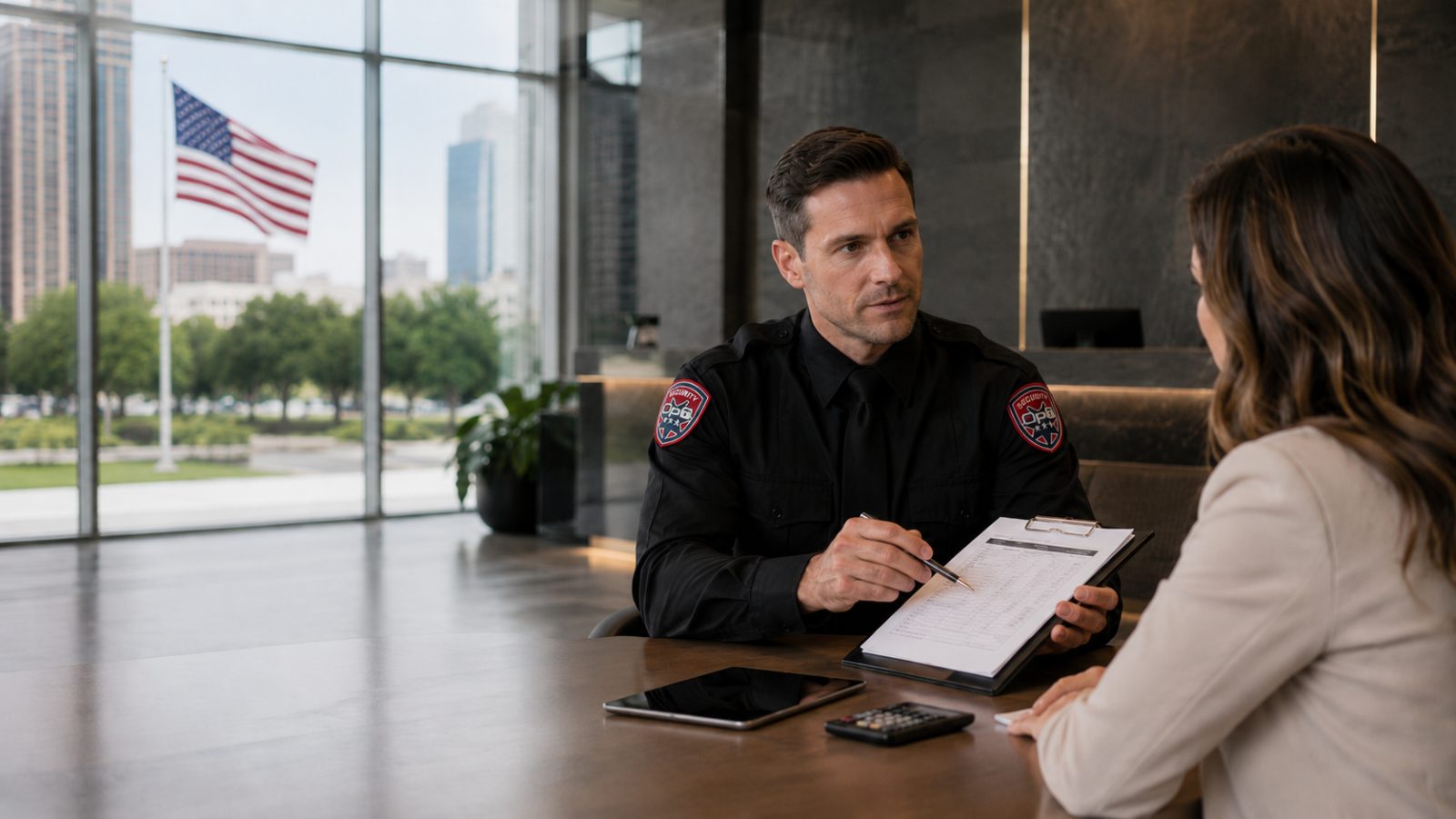
What we do instead: a confidential conversation about your needs, a written threat and operational assessment for non-trivial engagements, and an itemized proposal that shows you exactly what you’re paying for — officer time, supervision, insurance, equipment, and any specialty capabilities. You get clarity, not guesswork.
What drives the cost of your security program
The factors that move the number up or down on any quote:
- Armed vs. unarmed — armed coverage costs more because of additional training, qualification, and insurance, but is appropriate only when the risk profile justifies it
- Shift length and coverage model — 24/7 coverage uses approximately 4.2 full-time officers per post and prices differently than ad-hoc engagements
- Site risk profile — high-risk environments require different officer training and insurance loading than low-risk lobby work
- Officer training tier — Op6 trains at six times the Texas state minimum; that investment shows up in the rate and in measurably fewer incidents
- Equipment and vehicles — body cameras, GPS tracking, vehicles, K9 partners, and specialty PPE all factor in
- Volume and contract length — multi-site portfolios and longer-term contracts see meaningful efficiency
- Specialty capabilities — executive protection, school programs, event coverage, and other specialized engagements price differently than standard facility security
For a real number tailored to your situation, contact Op6 directly. We respond to most inquiries within one business day with an itemized proposal.
The Major Factors That Change Your Rate
Armed vs Unarmed
The largest single driver of hourly rate is whether the officer is armed. Texas Level II (unarmed) commission requires 6 hours of state training; Level III (armed) requires an additional 45 hours of classroom and range work, an annual qualification, fingerprint and background re-screening, and substantially higher insurance premiums for the security firm. That stack of regulatory cost is why armed officers run more per hour than unarmed peers. If your risk profile genuinely calls for a firearm — high-cash environments, late-night retail, executive protection, hostile termination scenarios — pay the premium. If it doesn’t, an unarmed officer is the right call. Op6 helps clients honestly assess which side of that line they fall on. See more on our armed officers and unarmed security programs.
Shift Length and 24/7 Coverage
A four-hour event coverage shift is priced very differently from a 168-hour-per-week 24/7 single post. 24/7 coverage requires roughly 4.2 full-time officers (factoring in PTO, sick leave, training time, and turnover backfill) plus management overhead, so the per-hour bill rate is typically lower than ad hoc shifts even though the total contract value is much higher. Volume earns volume pricing.
Site Risk Profile
A Class A office building lobby with a friendly access-control mission carries less officer risk than a 24-hour pawn shop in a high-crime corridor or a chemical plant during turnaround. Insurance and officer injury coverage for security firms is rated by assignment, and so is the bill rate the firm has to charge to remain solvent. Honest providers raise rates on higher-risk posts; budget firms hide the risk and pay it back later in turnover and lawsuits.
Officer Training Tier
Texas requires only 6 hours of training for a Level II commission. Op6 invests 6× that minimum across our entire workforce, with additional specialty modules in de-escalation, customer service, fire watch, executive protection, and active threat response. That training investment shows up in the hourly rate — and it also shows up in fewer incidents, lower client liability, and dramatically lower turnover. Read more about how our training program differs from the Texas baseline at The Difference.
Equipment
Vehicles, K9 partners, body-worn cameras, drones, and mobile surveillance trailers all roll into the rate. A K9 explosives or narcotics team is a specialized capability with specialized cost. Mobile camera trailers can offset officer hours on large sites — sometimes the most cost-effective Texas security plan is a mix of trailers, mobile patrols, and a small in-person guard footprint rather than a large standing officer presence.
Volume — Single Post vs Multi-Site Contract
If you’re staffing one 24/7 post, your per-hour rate will be higher than a portfolio client with 30 posts across Texas. Multi-site contracts let providers amortize recruiting, training, supervision, and management infrastructure across more billable hours. If you operate multiple Texas locations, ask any provider for tiered volume pricing.
Texas City Differences in Hourly Rate
Texas isn’t one labor market — it’s a dozen. Hourly rates trend with cost of living, demand, and regulatory enforcement intensity in each metro. Four things move the number between cities:
- Local wage floors. An officer in Houston or Austin will not take the wage that staffs the same post in the Rio Grande Valley, and the bill rate follows the wage, not the other way round.
- Competition for licensed officers. Metros with heavy energy, medical, and event demand run short of commissioned Level III officers, which bids up pay for armed posts specifically.
- Off-duty peace officer supply. Texas law exempts off-duty officers working private jobs from private security licensing, so in cities with a large, well-organised extra-job market they set an effective ceiling on what armed private security can charge.
- Travel and coverage density. A single post two hours from a provider’s nearest supervisor costs more to run than one in a city where they already have twenty officers and a patrol supervisor on shift.
Op6 staffs Houston and the surrounding metro, Austin, Brownsville and the Rio Grande Valley. Where a site sits relative to that footprint is a real input to the quote, and we will tell you plainly when a location is one where we are not the most economical option.
How Op6 Builds a Quote — Transparent Pricing Methodology
Op6 quotes follow a predictable structure so you can see exactly what you’re paying for.
- Site assessment: We tour your site or review documentation and identify risk exposures, access points, post locations, and coverage hours required.
- Officer specification: We recommend the appropriate officer tier (armed/unarmed, training specialty), supervisor coverage, and equipment.
- Coverage modeling: We calculate scheduled hours, anticipated overtime, and a realistic backfill factor based on Texas turnover norms.
- Bill rate calculation: We share the bill rate, what the officer is paid, and the line items (wages, taxes, insurance, equipment, overhead, profit) that make up the difference.
- Inclusions and exclusions: Everything that’s in scope is listed; everything that’s not is named with the rate that would apply if it’s added.
- Annual escalator: If the contract is multi-year, the escalator is named in the document.
You leave the quote conversation knowing what you’re buying, what you’re not, and what it costs to add anything else. For a deeper conversation about your specific site, see Services or contact us directly.
Frequently Asked Questions
What is the average security guard hourly rate in Texas in 2026?
There is no honest single average — the same officer costs a different amount in a Houston lobby, on a Permian site, and at a four-hour event, and any company quoting you one number before seeing your site is guessing. What Op6 will do instead is show you the whole build-up: your bill rate, what the officer is paid, and every line between the two. Send us your site details and you will have that in writing, usually within one business day.
What’s the minimum contract length?
Op6 supports event coverage as short as 4 hours and ongoing contracts as long as multi-year master service agreements. Most ongoing contracts are 12 months with 30-day cancellation rights.
Are armed officers always more expensive than unarmed?
Yes, by a meaningful margin in Texas — driven by the additional Level III training, annual firearms qualification, fingerprint and background re-screening, and elevated insurance loading required for armed work. The right tier for your site depends on the risk profile, not the rate differential alone.
Can I save money with cameras instead of guards?
Sometimes yes. A mobile camera trailer with live monitoring can replace some officer hours, especially on large open construction sites. Op6 designs hybrid programs that mix trailers, mobile patrol, and standing officers for the lowest defensible total cost.
What if I just need an emergency officer for tonight?
Op6 supports emergency deployments 24/7 across Texas. Same-day mobilization may include a small mobilization fee for non-contract clients, but the hourly rate matches our standard tiered pricing. Call us and we can have an officer on site within hours.
Get a Real Texas Security Quote in Under 24 Hours
Stop guessing what security should cost in Texas. Send us your site details and we’ll come back with a transparent, line-item quote — usually within one business day. No hard sell, no opaque “trust us” pricing. Visit /contact/ to request your 2026 Texas security guard quote.
Related Op6 resources
- Armed security guard cost in Houston
- Unarmed security guard cost in Houston
- Security guard companies near me
- Hire a bodyguard in Texas
- Cloud video surveillance in Texas
- Bodyguard for hire in Texas
Ready to Protect What Matters?
Get a free consultation with the Op6 Security team. No obligation. We will assess your needs and recommend the right protection plan for your situation.