
Table of contents
Three common apartment security options, side by side, so Houston property managers can match coverage to the problem and the budget.
Why Houston Apartment Security Isn’t One-Size-Fits-All
Multifamily properties don’t all face the same problems. A garden-style community with open breezeways has different exposure than a gated mid-rise with a single controlled entry. Loitering, package theft, after-hours noise, unauthorized pool use, and vehicle break-ins each call for a different response.
The three most common apartment security options in Houston — courtesy patrol, gate guard, and standing officer — solve different problems. Choosing well means matching the service to your actual incident pattern, not buying the most visible option and hoping it covers everything.
Courtesy Patrol: Roving Presence and Deterrence
A courtesy patrol is a mobile officer who moves through the property on foot or by vehicle at set or randomized times, usually during evening and overnight hours. It is the most cost-efficient way to establish a visible presence across a large or spread-out community.
Patrol works best when your concerns are dispersed — loitering in breezeways, after-hours pool access, parking-lot activity, and noise complaints. Because the officer is not fixed to one point, randomized rounds make it harder for problem behavior to predict gaps. Op6 patrols include GPS-tracked, photo-verified reporting so you can confirm where and when rounds happened.
- Best for: large or spread-out properties with dispersed issues
- Strengths: broad coverage, strong roving deterrence, cost-efficient
- Limits: not stationed at any single entry or trouble spot
- Typical hours: evenings and overnight, set or randomized rounds
Gate Guard: Access Control at the Entry Point
A gate guard is stationed at your community’s vehicle or pedestrian entrance to control who comes in. This is access management — verifying residents and guests, managing vendor and delivery traffic, and turning away non-residents before they’re on the property.
Gate guard service fits gated communities where the entry point is the main vulnerability. It creates a clear first line of accountability and a documented record of who entered. The tradeoff is that coverage is concentrated at the gate, so it pairs well with patrol when you also need eyes on the rest of the grounds.
- Best for: gated communities with a controlled entrance
- Strengths: access control, visitor/vendor screening, entry records
- Limits: coverage stays at the gate, not across the property
- Pairs well with: a courtesy patrol for interior grounds
Standing Officer: Fixed Post for High-Need Areas
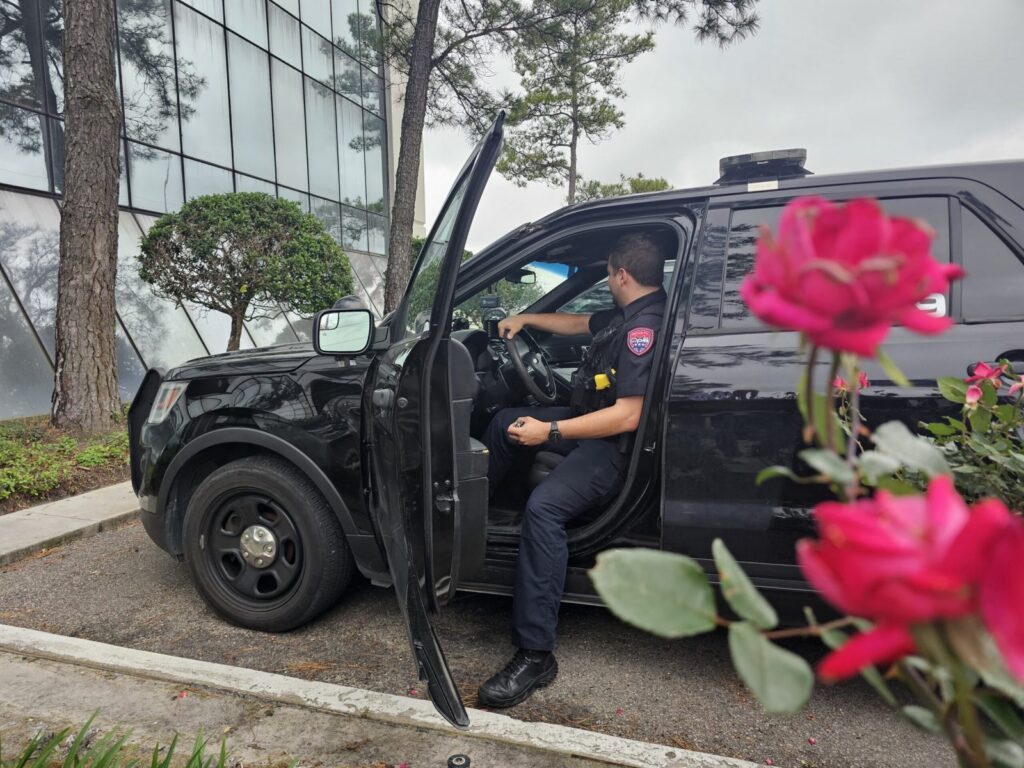
A standing (stationary) officer holds a fixed post — a leasing office, clubhouse, lobby, or a building that has seen repeated incidents. This is the strongest deterrent for a specific location because the officer is consistently present, visible, and immediately able to respond.
Standing officers fit properties dealing with an active, location-specific problem: a trouble building, ongoing trespassing, or a leasing team that needs on-site protection. For larger communities, a standing post is often combined with patrol so one hot spot is covered while the rest of the property still gets roving rounds.
- Best for: a specific hot spot or high-traffic location
- Strengths: maximum on-site deterrence and fastest local response
- Limits: covers one location, not the whole community
- Common posts: leasing office, lobby, clubhouse, problem building
How to Choose — and Why Many Properties Blend Options
Start with your incident log. If problems are spread across the grounds, lean patrol. If the entrance is the weak point, a gate guard. If one location drives most of your calls, a standing officer. Many Houston communities end up blending two — a standing post at a trouble building plus overnight patrol everywhere else.
Beyond the option itself, weigh coverage hours, whether you need armed or unarmed officers, and reporting. Op6 fields armed officers with a Texas DPS Level III commission and unarmed officers with a Level II registration, all background-vetted and trained up to 6x the state requirement in de-escalation and scenario drills. Every assignment includes 24/7 dispatch and photo-verified reporting.
- Map your incidents first — where and when they actually happen
- Decide on hours: overnight only, peak evenings, or 24/7
- Choose armed vs. unarmed based on the threat level
- Confirm reporting: GPS tracking, photo verification, dispatch access
- Consider a blend when one option leaves obvious gaps
Talk to a Veteran-Owned Houston Security Team
Op6 Security is a veteran-owned Texas company founded by a former Houston-area police officer and military veteran, licensed by the Texas DPS Private Security Bureau (License #C26264901). We cover apartment and multifamily security, courtesy patrol, residential and HOA work, and more across Houston and Texas.
The fastest way to pick the right apartment security option is a free, no-pressure assessment. We’ll walk your property, review your incident history, and recommend a fit. Call 832-304-4301 to get started.
Key Takeaways
- Courtesy patrol gives broad, roving deterrence across spread-out properties
- Gate guards control access at a single entrance and screen visitors
- Standing officers deliver maximum presence at one high-need location
- Start with your incident log to match the option to the real problem
- Many Houston communities blend two options to close coverage gaps
- Op6 is veteran-owned, TX DPS-licensed, with photo-verified reporting and 24/7 dispatch
Frequently Asked Questions
What’s the difference between a courtesy patrol and a standing officer?
A courtesy patrol moves through the whole property on set or randomized rounds, giving broad roving deterrence. A standing officer holds one fixed post — a lobby, leasing office, or trouble building — for maximum presence in a single high-need spot. Many properties use both.
Do I need armed or unarmed officers for my apartment community?
It depends on your risk level and history. Unarmed officers (TX DPS Level II) handle access control, patrols, and deterrence at most communities. Armed officers (TX DPS Level III) fit higher-risk situations. Op6 can recommend the right fit during a free assessment.
Can I combine more than one apartment security option?
Yes, and many Houston properties do. A common blend is a standing officer at a hot-spot building plus an overnight courtesy patrol across the rest of the grounds, or a gate guard paired with interior patrols. We build the mix around your incident pattern.
How much does apartment security cost in Houston?
Cost depends on the option, coverage hours, armed vs. unarmed, and property size, so there’s no flat number. The best way to get an accurate picture is a free property assessment. Call Op6 at 832-304-4301 to review your needs.
Ready to put trained, licensed officers on your property? See our Apartment & Multifamily Security in Houston, TX page or call 832-304-4301 for a free, no-obligation assessment.
Talk to Op6 Security
Get licensed, veteran-led officers matched to your property and your risk — GPS-tracked, photo-verified, and backed by 24/7 dispatch. Free, no-obligation consultation.