
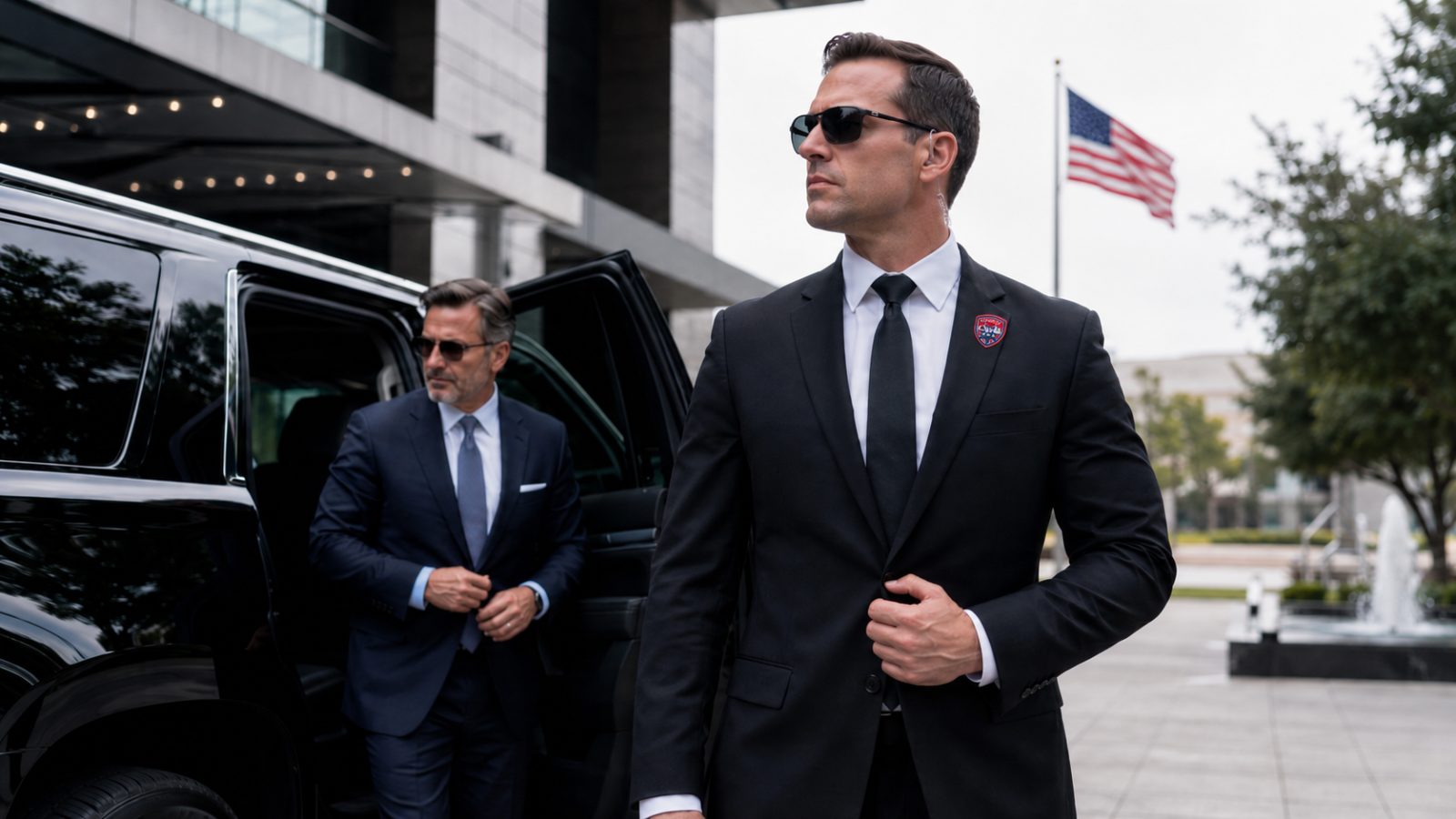
Executive Protection
If you’re searching for a bodyguard for hire in Texas, you almost always have a specific reason in mind: a threat, a stalker, a hostile ex, a court date, an out-of-state trip, or a high-stakes business deal where things could turn physical. You don’t need a sales pitch. You need clear answers about what a bodyguard actually does, what it costs, what’s legal in Texas, and how to make sure the person you hire is someone you’d actually trust to stand between you and harm.
This page is written for that buyer. Op6 Security Services provides licensed, vetted, and continuously trained executive protection agents across Texas, with primary operations in Houston and full coverage in Austin, Dallas, San Antonio, Fort Worth, and Brownsville. Our agents complete six times the training hours required by the State of Texas, carry military or law enforcement backgrounds, and are tracked by GPS in the field for accountability. Below is everything you need to know before you pick up the phone.
When You Should Actually Hire a Bodyguard
Most people who reach out to us aren’t celebrities. They’re business owners, divorcing spouses, doctors, real estate developers, oil and gas executives, abuse survivors, and ordinary families who suddenly find themselves in a situation that requires a trained protector. The trigger is almost always one of the following:
Stalking and Repeated Unwanted Contact
If someone is showing up at your home, your workplace, or your child’s school after being told to stop, that’s a stalking pattern. Police can take a report, but they can’t be on you twenty-four hours a day. A bodyguard fills that gap legally and immediately. Many of our long-term clients started as stalking cases.
Direct or Implied Threats
Threats arrive by text, email, social media DM, voicemail, or in person. Some are vague (“you’ll regret this”), some are specific (“I know where you park”). Specific threats from someone with the means and history to act on them are a hard trigger to engage protection while law enforcement and legal counsel work their side.
Divorce, Custody, and Domestic Disputes
High-conflict divorces, especially where one party has a history of violence, control, or substance abuse, are one of the most common reasons people hire a bodyguard in Texas. Court appearances, child exchanges, document service, and moving day are all flashpoints. A trained agent reduces the chance that things escalate.
Business and Financial Risk
Terminating a problem employee, evicting a hostile tenant, closing a contentious deal, carrying large amounts of cash or product, and onsite presence at a property dispute all benefit from a professional. Insurance claims investigators, repo agents, and process servers also retain bodyguards in volatile situations.
Public Profile
If your face is on local TV, your name is on a building, you’ve gone viral, or you’re testifying in a high-profile case, your exposure has changed. Public-profile clients usually pair a bodyguard with broader executive protection planning. Our guide to seven high-risk profiles in Texas covers this in detail.
Travel
Out-of-state and international travel introduces unfamiliar risks: airports, hotel lobbies, ground transport, restaurants, and venues you didn’t choose. A travel bodyguard handles route planning, advance work, and on-the-ground security so you can focus on your reason for traveling. See our corporate travel protection page for the full scope.
Types of Bodyguards You Can Hire
“Bodyguard” is a general term. Op6 deploys agents in five primary configurations depending on the threat picture and the client’s life:
Single-Agent Protection
One trained agent assigned directly to the principal (the protected person). This is the most common engagement: a single agent for a court date, a meeting, an event, or a multi-day assignment. Suitable for low-to-moderate threat profiles or short-duration needs.
Protective Detail (Two or More Agents)
Two-agent and multi-agent details are used when the threat is credible, when the principal moves through unpredictable environments, or when 360-degree coverage is required. A typical detail includes a personal protection officer next to the principal, a driver who never leaves the vehicle, and an advance agent clearing the next location.
Residential Protection
Static or roving agents at the home, often during a specific window of risk: after a threat, during a contested divorce, while a stalker is unaccounted for, or when the principal is traveling and the family stays behind. Residential posts can run 24/7 or cover specific shifts.
Travel Protection
Agents who travel with the principal domestically or internationally. Includes airport meet-and-greet, secure ground transportation, hotel room sweeps, restaurant advance work, and emergency evacuation planning.
Event Protection
Coverage for weddings, fundraisers, concerts, conferences, depositions, large family gatherings, and celebrity appearances. Event work is its own discipline because the threat shifts from a known adversary to crowd control, uninvited guests, and reputational risk. Our high-profile events page covers the methodology.
Bodyguard vs. Executive Protection: The Real Difference
The words are used interchangeably online, but in our industry they describe two different products. A bodyguard is reactive: a physical deterrent and last-line responder. Executive protection is proactive: threat assessment, route planning, advance work, secure transportation, residential security review, communications protocols, and a trained agent or team in addition to the physical presence.
For a one-time court appearance or a single travel day, a bodyguard is usually sufficient. For ongoing risk, a public profile, or a situation that has the potential to evolve, executive protection is the right product. We’ve written a longer breakdown on the bodyguard vs. executive protection comparison page, and our main executive protection hub covers the full service line.
What a Texas Bodyguard Actually Does
The job is mostly observation, planning, and de-escalation. Used correctly, a professional bodyguard prevents incidents instead of reacting to them. On a typical assignment, the agent will:
- Conduct a threat assessment before the engagement begins
- Brief the principal on expected risks and protocols
- Plan routes, identify safe rooms, and pre-clear destinations
- Drive or coordinate secure transportation
- Maintain a low-profile presence in public
- Screen approaches, identify surveillance, and monitor for hostile behavior
- Hold a position between the principal and any developing threat
- Coordinate with law enforcement when required
- Document the assignment and report back
What a Bodyguard Does Not Do
Movies and television have done damage to client expectations. A real bodyguard is not a hitman, an investigator, a process server, or a hired enforcer. We do not retrieve people, deliver messages, intimidate third parties, or conduct surveillance on someone else. We do not break the law for clients. An agent who would do those things is not someone you want responsible for your safety.
If you have a problem that requires those services, the right professionals are private investigators, attorneys, process servers, and sometimes law enforcement. Op6 will refer you and then work alongside them in a protective role.
Texas Legal Context: What’s Actually Required
Texas regulates the security industry through the Texas Department of Public Safety (DPS), Private Security Bureau. The rules that matter when hiring a bodyguard:
Personal Protection Officer License
To work as an armed personal protection officer in Texas, an individual must hold a Personal Protection Officer (PPO) endorsement from DPS, which requires a Level III security commission and additional Level IV PPO training. The agent must also be employed by or contracted through a licensed security company. Hiring an unlicensed friend “as security” exposes both of you to legal risk.
License to Carry vs. Security Commission
A Texas License to Carry (LTC, formerly CHL) lets a private citizen carry a handgun. It does not authorize them to act as a paid bodyguard. Paid armed protection requires the Level III commission and, for protective work, the PPO endorsement. Anyone advertising bodyguard services without these credentials is operating outside the law.
Armed vs. Unarmed
Not every assignment requires an armed agent. Unarmed protection (Level II) is appropriate for low-threat environments, hospitality and venue settings, and situations where a firearm would be inappropriate or prohibited (courthouses, schools, certain private events). Op6 deploys both based on the threat assessment. See our armed officers page for credentialing details.
Legal Authority
A bodyguard is not a peace officer. They have the same legal authority as any private citizen plus the lawful ability to carry a firearm in the course of duty. They can act in lawful defense of the principal and in defense of third parties under Texas Penal Code chapters 9.31-9.33. They cannot detain people for questioning, conduct searches, or use force outside lawful defense.
How to Vet a Bodyguard Before Hiring
The single biggest mistake people make is hiring on price or vibe. Use this checklist:
Verify the License
Ask for the company’s DPS license number and the agent’s commission and PPO numbers. Verify them on the DPS Private Security Bureau public lookup. If the company won’t provide them, walk away.
Confirm Insurance
Background of the Agent
Ask about the specific agent assigned to you, not just the company. Military service, law enforcement experience, prior protection assignments, languages, medical training, and continuing education all matter. Op6 agents go through six times the state-required training hours, with quarterly recertification.
References
Ask for two or three professional references from clients within the last twelve months. A serious firm will provide them under NDA. Call them.
Written Threat Assessment
Before quoting a price, a competent provider will conduct or at least scope a threat assessment. If the first conversation is a flat hourly quote with no questions about your situation, that’s a red flag.
The Op6 Hiring Process
Step 1: Confidential Consultation
You call or use the form on our contact page. A senior team member, not a sales rep, takes the call. We listen, ask focused questions, and protect your information under NDA from the first sentence.
Step 2: Threat Assessment
We evaluate the specific threat (who, what, when, history), your exposure (home, work, family, travel), and the operational picture (locations, schedule, third parties). For complex cases this is a written document; for time-sensitive engagements it can be completed verbally within hours.
Step 3: Agent Matching
We match the agent to the assignment. A discreet residential post for a divorcing executive looks different from an event detail for a public figure. Considerations include language, gender, presentation, professional background, and operational specialty. Read more about our approach and standards.
Step 4: Deployment
We brief the agent, brief the client, finalize the operations plan, and deploy. For ongoing engagements, you have a single point of contact at Op6 plus the agent on the ground. GPS tracking and check-in protocols are standard. Our technology page details the systems.
Step 5: Debrief and Adjustment
Every engagement ends with a debrief. For ongoing details, we adjust the plan as the threat picture changes.
Pricing: What Drives the Number
We don’t publish flat hourly rates because they’re misleading. The honest factors that drive cost:
- Armed or unarmed. Armed agents carry higher credentials and higher liability, and price accordingly.
- Number of agents. A single-agent assignment is the floor; details scale linearly.
- Hours and shift structure. 24/7 coverage requires a rotation of three to four agents to be sustainable.
- Travel and per diem. Out-of-area work includes lodging, meals, and travel time.
- Threat level. Higher threats require more advance work, more agents, and senior personnel.
- Specialty requirements. Multilingual, female agents, medic-trained, or covert-trained personnel are billed differently.
- Equipment. Armored transport, communications gear, and counter-surveillance technology when warranted.
For a deeper look at typical ranges and how protection budgets are built, read our cost guide for executive protection in Texas.
Confidentiality and NDAs
Every Op6 engagement starts under a mutual NDA. Agent identities, client identities, schedules, locations, and the existence of the engagement itself are protected. For high-profile clients, we operate in low-profile mode with no branded vehicles, no logos, and no obvious tactical gear. Our discreet executive protection page details how we run covert protection.
Frequently Asked Questions
How fast can you deploy a bodyguard in Texas?
Houston-area emergency deployments can be on the ground within two to four hours. Statewide, same-day is typical. Planned engagements are scheduled days or weeks in advance.
Can I hire a bodyguard for just a few hours?
Yes, with a minimum engagement (typically four to eight hours depending on the assignment). Court appearances, document service, single meetings, and one-day events are all common short-form engagements.
Do I need to file a police report first?
No. We work alongside law enforcement when appropriate, but you do not need a police report or a restraining order to hire a bodyguard. That said, if there’s a credible threat, we’ll often recommend filing a report and may help coordinate.
Will a bodyguard look like a bodyguard?
Only if you want them to. Visible deterrence is appropriate for some assignments. For most private clients, our agents dress to match the environment (business casual, suit, or event-appropriate) and operate discreetly.
Can I hire an Op6 armed protective officers instead?
Op6 armed officers are excellent for static security at events and venues, but full-time executive protection is a different discipline. A licensed PPO with protection-specific training will almost always outperform an Op6 armed officers in a dynamic protection scenario.
Will you sign an NDA?
Yes. Confidentiality is built into every engagement. We will sign your NDA, ours, or a mutual one before any details are exchanged.
What areas of Texas do you cover?
Houston is our primary operating area. We deploy regularly in Austin, Dallas, Fort Worth, San Antonio, and Brownsville. We handle out-of-state and international assignments by request.
What if the threat goes away?
You can stand down at any time. Ongoing details are billed by the period in use, with reasonable notice for shift planning.
Hire a Bodyguard in Texas
If you’re at the point where you’re searching online for a bodyguard, you’ve already decided you need one. The next step is a confidential conversation with a team that will tell you the truth about your situation, including whether you actually need protection and at what level. Call Op6 or reach out through our contact page for a private consultation. We answer twenty-four hours a day, every day of the year, and the first conversation is always under NDA.
Ready to Protect What Matters?
Get a free consultation with the Op6 Security team. No obligation. We will assess your needs and recommend the right protection plan for your situation.