
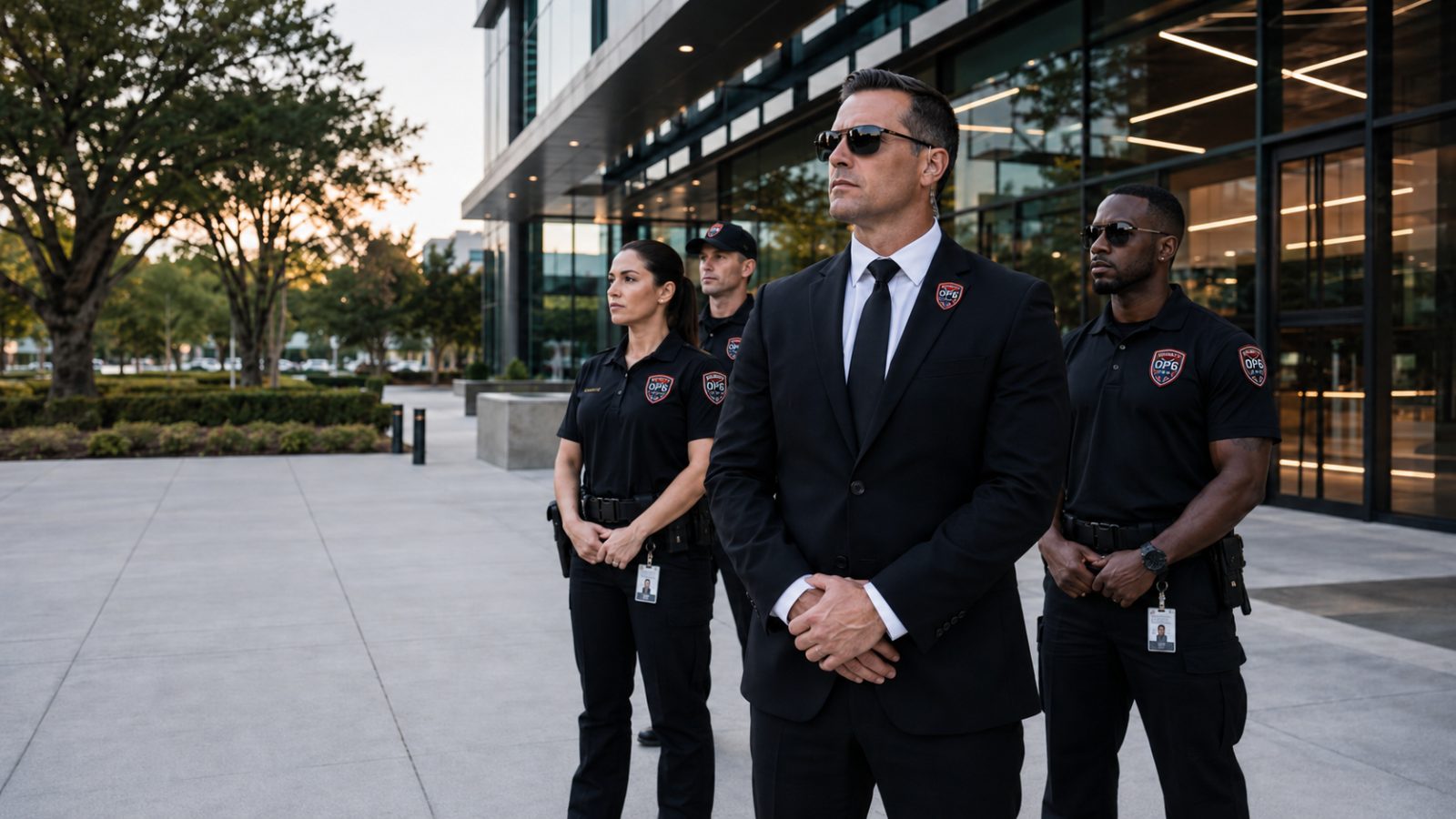
Licensed Guards
“Security guard companies near me” is a more specific search than it looks. You’re not shopping for cameras, alarm monitoring, or cyber consulting — you’re hiring human beings to stand a post, walk a perimeter, document what they see, and intervene when something goes wrong. The quality of those humans, and the company that trains, supervises, and equips them, determines whether your investment actually reduces risk or just produces a uniformed presence that fails the first time it’s tested.
Op6 Security Services is a Texas-licensed guard company operating in Houston, Austin, Dallas, Fort Worth, San Antonio, and Brownsville. We staff armed and unarmed posts for residential, commercial, retail, healthcare, construction, and energy clients across the state. This page is the working buyer’s guide to hiring guard services in Texas — what to look for, what drives cost, what red flags should kill a deal, and how Op6’s deployment process actually works.
Security Guard Companies vs. Security Technology Providers
The security industry blurs categories on purpose. A company selling alarm monitoring will quote you “security services.” An IT firm pitching network protection will use the same word. When you specifically need guards, you need to filter for operators whose primary business is running licensed, uniformed officers — not companies bolting guard service onto a hardware contract.
A real guard company has:
- A current Texas DPS Private Security Bureau Class B (Guard Company) license
- An in-house roster of TX DPS-licensed Level II, III, and IV officers
- Field supervisors who actually work the metros they serve
- A documented training program beyond state minimums
- A real-time activity tracking platform — not a paper logbook
- Insurance specifically rated for armed and unarmed guard operations
A technology provider with guards on the side typically has none of those at the depth required to run a serious post. Op6 is a guard-first operator with technology layered on top, not the reverse. Our technology platform exists to make our officers more accountable and effective, not to replace them.
Types of Guard Services Op6 Provides
Armed Officers (TX DPS Level III/IV)
Commissioned officers carrying sidearms, deployed when threat profile, cash handling, controlled-substance environments, or post history justifies lethal-force capability. Common posts: bank lobbies, jewelry stores, cannabis dispensaries, after-hours retail, executive offices with credible threat history, and any location with documented violent incidents in the prior 24 months. See armed officers for full deployment criteria.
Unarmed Officers (TX DPS Level II)
Uniformed deterrent presence, access control, and observe-and-report posts. The right call for lobbies, residential gates, retail centers without elevated threat history, construction site daytime coverage, and corporate front desks with security duties. Less expensive than armed coverage and appropriate for the majority of low-to-moderate-risk environments. Details on unarmed security.
Plain-Clothes Officers
Loss prevention, surveillance, and asset protection without the uniformed footprint. Heavy use case in retail (organized retail crime detection, internal theft surveillance) and event security where a uniformed presence would change the dynamic.
Executive Protection / Bodyguards
Close-protection details for executives, public figures, high-net-worth principals, and family members. Includes residence coverage, secure transportation, advance work for travel and events, and coordination with local law enforcement when threats warrant. Op6’s bodyguard and executive protection teams are staffed almost exclusively by former military and law enforcement.
Vehicle Patrol
Marked and unmarked patrol vehicles running randomized routes through HOAs, retail centers, multi-tenant office parks, and construction sites. Combines visible deterrence with rapid response across multiple addresses on a single contract.
Stand-Up Posts vs. Roving Posts
Stand-up posts hold a fixed location (gate, lobby, dock). Roving posts patrol a defined area on randomized timing to defeat surveillance and reconnaissance. Most properties benefit from a hybrid — fixed coverage at the highest-value choke points and roving coverage everywhere else.
Texas Industries That Need Guard Services
Oil, Gas, and Energy
Pipeline yards, drilling sites, refineries, and midstream facilities across the Permian, Eagle Ford, and Houston petrochemical corridor face copper theft, equipment theft, and trespass risk. Remote-yard coverage often combines on-site officers with camera trailers for cost-effective layered protection.
Construction
Retail
Shrink, organized retail crime, and increasingly violent shoplifting incidents have turned retail security from a compliance line item into a frontline operational priority. Op6’s retail security services page covers tactics specific to anchor stores, big-box, jewelry, and luxury retail in Texas markets.
Healthcare
Hospital ERs, behavioral health units, and medical office buildings face workplace violence at rates higher than most industries. Officers in healthcare environments need de-escalation training, restraint awareness, and HIPAA fluency — all standard in Op6’s curriculum.
Residential and HOA
From single-family residences with active threats to gated subdivisions and high-rise condos, residential guard work requires a different posture than commercial. Residents are the customers, vendors and visitors are constant, and officers must enforce community standards without becoming the source of complaints. Op6’s residential security in Houston deployments illustrate the model.
Logistics and Distribution
Truck yards, warehouses, and distribution centers — particularly along the Houston port corridor and DFW logistics belt — need access control at gates, trailer seal verification, and after-hours roving coverage.
Texas Licensing Requirements: What’s Actually Required
The Texas DPS Private Security Bureau (PSB) sets the floor. Knowing the floor lets you tell when a company is meeting it versus exceeding it.
Company-Level (Class B License)
Any business providing guard services in Texas must hold a PSB Class B license. The license number is public and verifiable on the PSB website. Operating without one is a criminal offense; subcontracting to an unlicensed company creates liability for the client.
Officer-Level Licensing
- Level II — Non-Commissioned Security Officer: 6 hours of state-mandated training. Cannot carry a firearm on duty.
- Level III — Commissioned Security Officer: 45 hours of training plus annual firearms qualification. Authorized to carry handgun on duty.
- Level IV — Personal Protection Officer: Additional 15 hours of training on top of Level III, authorized for executive protection.
Why Op6 Trains at 6× the State Minimum
The state floor produces officers who are legally permitted to work — not officers who are operationally ready for a complex post. Op6’s curriculum stacks additional hours of:
- Verbal de-escalation and crisis communication
- Use-of-force law and case-law application
- Report writing under legal scrutiny
- First aid, CPR, and Stop the Bleed
- Radio procedure and team communication
- Post-specific scenarios (healthcare, retail, residential, executive protection)
- Active-threat response and evacuation coordination
Quarterly refreshers keep officers sharp. The the difference page details the full curriculum.
What Drives the Cost of Hiring Security Guards in Texas
We don’t publish hourly rates, because honest pricing requires understanding the post. But the variables that drive cost are universal across the industry:
Armed vs. Unarmed
Armed posts cost more — higher officer pay grade, higher insurance load, and tighter training requirements.
Hours of Coverage
24/7 coverage requires roughly 4.2 full-time officers per post (accounting for shift coverage, PTO, and overlap). Part-time or after-hours-only contracts have lower headcount needs.
Officer Experience and Specialty
Executive protection, K9 handlers, plain-clothes loss prevention, and former-LE officers carry premium rates above standard uniformed coverage.
Site Risk Profile
Insurance underwriting reflects post-specific risk. A bank lobby and a quiet office building cost different amounts even at the same hours.
Geography
Houston, Austin, and DFW pricing reflects local labor markets. Rio Grande Valley and outlying areas may price differently based on supervisor coverage and travel.
Equipment and Vehicles
Marked patrol vehicles, body-worn cameras, radios, and any specialized equipment factor into the contract.
Contract Length
Long-term contracts (12+ months) often unlock better rates than short-term or single-event work because of training amortization and roster stability.
Red Flags When Hiring a Security Guard Company
If you encounter any of these during the sales process, walk away — they predict operational failures you’ll discover at the worst possible time.
- No PSB license number provided on request. This is non-negotiable and public information. Any hesitation means there’s a problem.
- Quotes given without a site survey. Honest operators see the post before pricing it. Phone-only quotes mean the company doesn’t know what they’re being asked to do — or doesn’t care.
- Vague answers about training. “We meet the state requirements” is the floor. Push for specifics.
- No real-time reporting platform. If after-action reports come days late on email attachments, supervision is broken.
- Reluctance to provide a Certificate of Insurance. COIs are routine. Reluctance signals lapses or inadequate limits.
- Officer turnover not discussed. Industry-wide turnover is high. Companies that don’t have an answer for how they retain officers will rotate strangers through your post.
- Promises of “former Navy SEAL” rosters at standard rates. Operationally serious companies don’t market that way.
- Heavy national branding, thin Texas presence. National companies subcontract Texas work constantly. You want operators with their own boots in your metro.
The Op6 Deployment Process
Here’s exactly what happens between your first call and officers on post.
Step 1: Discovery Call (Day 0)
15–30 minutes. We capture site address, threat history, hours needed, armed vs. unarmed preference, and any active incidents driving the request. If it’s an emergency, we move to surveying immediately.
Step 2: Free Site Survey (Day 0–1)
An Op6 supervisor walks the property, identifies access points, blind spots, lighting gaps, vehicle approaches, and operational considerations. We build post orders specific to your site — not a template.
Step 3: Written Proposal (Day 1–2)
You receive a written quote that breaks out hours, officer counts, armed/unarmed mix, equipment, supervisor coverage, and pricing. No surprises.
Step 4: Contract and Onboarding (Day 2–3)
Signed contract triggers officer assignment, post-order finalization, and client portal setup. You get login credentials to track everything that happens on your property in real time.
Step 5: First Shift (Day 3–4)
Officers report to post in proper uniform and equipment. Supervisor performs an on-site walk-through with the lead officer. First Daily Activity Report is delivered to your portal that shift.
Step 6: Ongoing Supervision
Supervisors run randomized post checks — physical inspections of officers on shift to verify uniform, equipment, alertness, and compliance with post orders. GPS data is reviewed weekly. Monthly account reviews surface trends and recommend adjustments.
Emergency deployment compresses this entire timeline into hours rather than days.
Frequently Asked Questions
What’s the difference between a security guard company and a security firm?
“Security firm” is a marketing term that can mean anything from cyber consulting to alarm monitoring. A security guard company is specifically a TX DPS Class B-licensed operator providing licensed Level II, III, and IV officers. When you need humans on post, hire a guard company.
Are Op6 guards bonded and insured?
Yes. Op6 maintains general liability, professional liability (errors and omissions), and comprehensive officer injury coverage coverage. Certificates of insurance are provided to clients on request and named additionally insured where required.
Can I hire guards for one-time events instead of ongoing coverage?
Yes. Op6 staffs single events — corporate functions, weddings, concerts, political events — alongside our ongoing accounts. Rates and minimums depend on guest count, hours, and security profile.
How does Op6 supervise officers on post?
Three layers: real-time GPS tracking on every officer, randomized in-person supervisor checks, and a digital reporting platform that timestamps every patrol checkpoint and incident report. Clients see all of it through the technology portal.
What if I’m not happy with an officer assigned to my site?
You request a replacement. We rotate the officer off your post, no friction, no questions. Officer fit is part of the service. You’re paying for the right person on your property — not a body in a uniform.
Can Op6 handle multi-site contracts across different Texas cities?
Yes. Multi-metro contracts are a core competency. We coordinate consistent post orders, training standards, and reporting across Houston, Austin, DFW, San Antonio, and Brownsville from a single account manager. See the full services hub for capabilities.
Hire a Texas Guard Company That Earns the Post
Most “security guard companies near me” search results are interchangeable on paper. The difference shows up at 2 a.m. when something actually happens — when the officer either responds correctly or doesn’t, when the report either documents what happened or doesn’t, when the supervisor either picks up the call or doesn’t.
Op6 was built for the moments that actually matter. Six times the state-required training. GPS tracking on every shift. Real-time digital reporting. Military and law-enforcement backgrounds across the roster. Texas-only operations with deep coverage in every metro we serve.
Contact Op6 today for a free site survey and written quote. No phone-pricing games, no national-call-center handoffs, no subcontracted strangers on your property. Just a Texas operator who shows up, does the work, and reports it accurately.
Ready to Protect What Matters?
Get a free consultation with the Op6 Security team. No obligation. We will assess your needs and recommend the right protection plan for your situation.